Was jeff dahmer archbishop Weakland's Convenient Distraction?
In the summer of 1991, Jeff Dahmer gets arrested, and Milwaukee suddenly has its own horror franchise. Acid drums, skulls in the fridge, cannibalism, sex zombies…it’s a media feeding frenzy that goes international overnight.
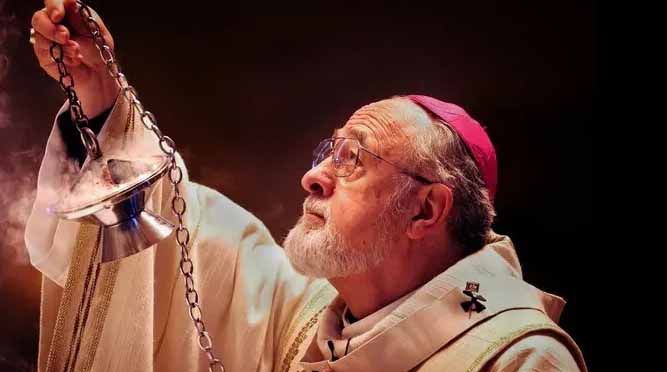
Watching from the wings: Archbishop Rembert Weakland, Milwaukee’s closeted Catholic boss since 1977, quietly juggling an expanding abuse crisis inside his Archdiocese. His tenure overlaps perfectly with both the “serial killer” circus and the Church’s slow-burning problem with pedophile priests.
Weakland would later resign in disgrace, and by 2019, his name was quietly erased from Archdiocese property. But in July ’91, he didn’t need to run damage control. The spotlight was busy elsewhere.
Too Many Skeletons, Not Enough Closets
Rembert Weakland sold himself as the Catholic Church’s resident reformer…talking economic justice, holding “listening sessions,” and projecting just enough progressivism to win headlines without upsetting Rome too much. Behind the scenes, it was the same old shell game: shuffle the predators, send them to “treatment,” and keep the cops out of it.
But…by 1991, Archbishop Weakland’s grip on his reputation was starting to slip. He’d been fielding allegations against Father Lawrence Murphy…who allegedly molested up to 200 deaf children at St. John’s School for the Deaf…since 1977.
Survivors were getting organized, with SNAP beginning to link victims who had previously been treated like isolated outliers. Courts were warming up to the idea that institutions…including the Catholic Church…might actually be responsible for harboring predators. And the media, still a decade away from the Boston Globe’s big Spotlight moment, was finally starting to sniff around. The wall was cracking. All Weakland needed now was a louder scandal to hide behind.
When Saying Nothing Says Everything
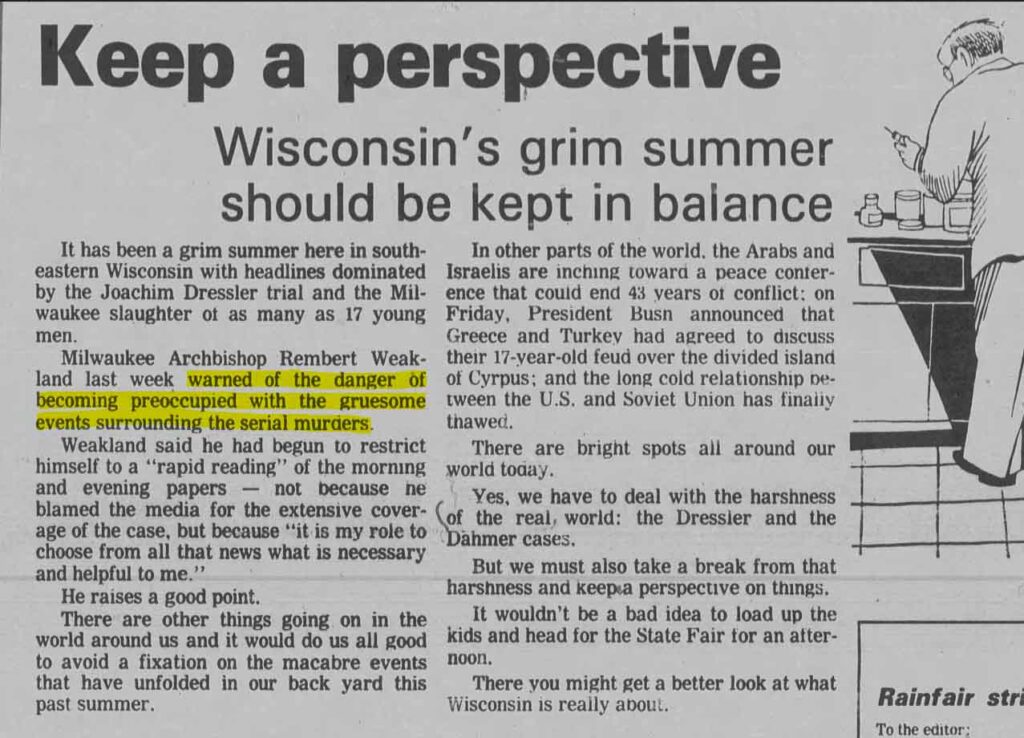
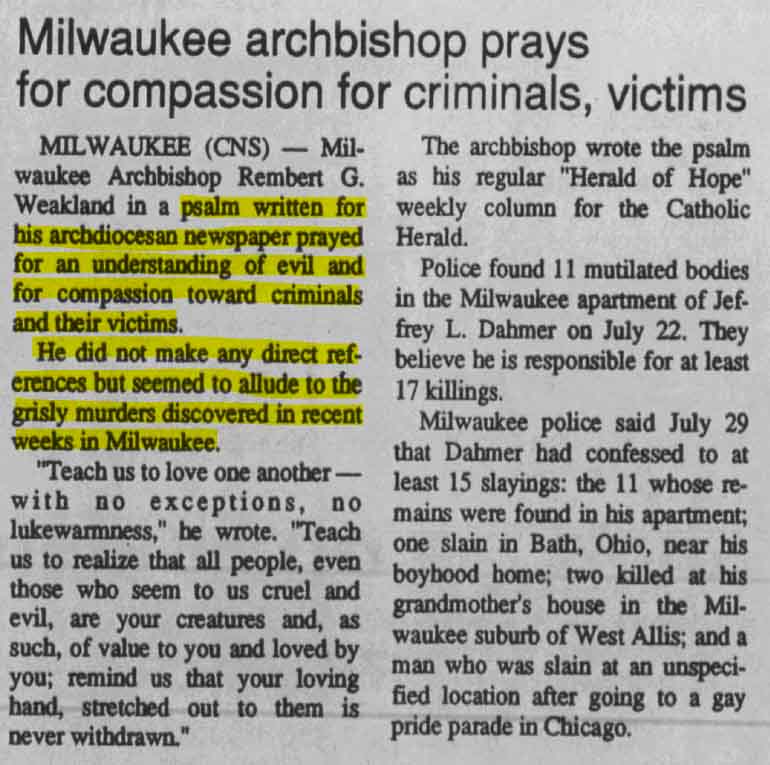
While Milwaukee was in meltdown over an alleged serial killer, Archbishop Weakland kept his distance. His contribution to the city’s collective trauma? A warning not to get too “preoccupied” with the grisly murders, plus a vague psalm about “understanding evil”….while carefully avoiding Jeff Dahmer’s name. For a man who never missed a chance to posture in public, it was an oddly convenient time to go mute.
Weakland’s radio silence makes a lot more sense once you realize what the “serial killer” story actually did: it set the bar for evil so high that the Church’s own predators started to look almost quaint.
What Is Anchoring Bias?
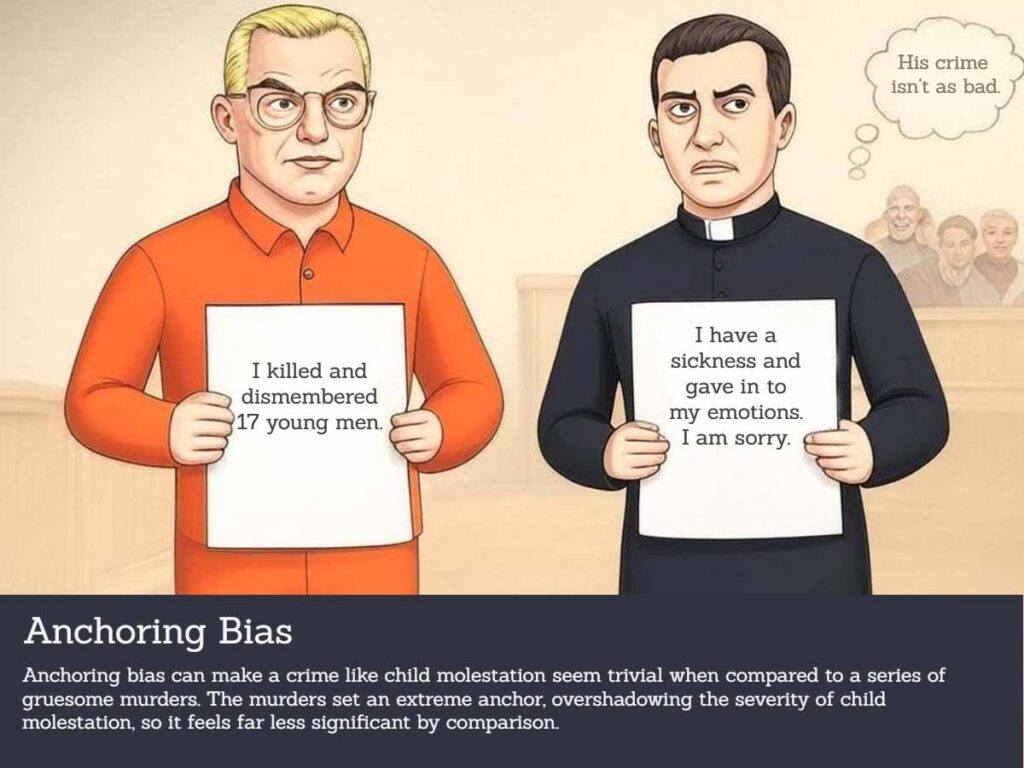
Psychologists have a term for the way your brain gets hijacked by the first shocking thing it sees: anchoring bias. Once an extreme example is planted in your head, everything that comes after it gets measured against that. Objectivity goes out the window.
It’s why a $1,500 couch looks like a steal after you’re shown a $3,000 one. Or why starting a salary offer at $70K magically drags the whole negotiation higher. The point isn’t logic…it’s leverage. You anchor people to something outrageous, then watch them recalibrate their definition of “reasonable.”
Jeff Dahmer: The Perfect Psychological Anchor
The “serial killer” story about Jeff Dahmer didn’t just shock people…it recalibrated their moral compass. By flooding the airwaves with the most cartoonishly evil behavior imaginable, it made every other form of predation look like a lesser offense by comparison. Including, conveniently, the kind of abuse Weakland’s priests were being accused of. Here’s how the trick worked in practice:
Creating an Extreme Reference Point
The “serial killer ” story came packed with every horror-movie trope the press could cram into a headline:
Murder
Necrophilia
Freezers and acid barrels full of body parts
DIY brain surgery to make “sex zombies”
Cannibalism
It was pure lurid spectacle…the stuff of a late-night gore reel. The press ran it nonstop, hammering it into a perfect “10” on the evil scale. The side effect? That scale got permanently warped. Everything else suddenly looked like a 3 or 4 by comparison.
For Weakland, the timing couldn’t have been better. Just as pressure over his protection of predatory clergy was starting to mount, along came a new benchmark for evil…one he had nothing to do with. Allegedly.
Want to examine the Dahmer case directly? Start with the records:
→ Was Konerak Sinthasomphone Even Real?
→ Richard Guerrero Died in 1960
→ Who Was “Eddie Smith” in the Dahmer Case?
→ Is This Man Curtis Straughter?
How to Make a Predator Priest Look Reasonable
Once Jeff Dahmer became the gold standard for depravity, the public’s moral scale broke. Suddenly, allegations against pedophile priests didn’t land like they used to. What might’ve once felt like an 8 or 9 on the societal outrage scale now clocked in at a 4…maybe a 3, if the guy says he’s sorry.
And that shift didn’t need to be conscious. The reflex kicked in on its own: “Well, at least Father So-and-So didn’t drill anyone’s skull or eat a bicep.”
Compared to Jeff Dahmer, predatory priests now started to look like deeply confused men who made tragic mistakes…just the kind of framing Weakland had been quietly pushing all along. It was his playbook. Send the accused priests for psychological treatment, shuffle them to a new parish, and keep it quiet. Compared to dismemberment and cannibalism, spiritual weakness started to sound managable.
By 2008, Weakland wasn’t even pretending anymore. In a deposition that year, he flatly admitted he didn’t see the sexual abuse of minors as a crime. On its own, that would’ve sounded insane. But next to Jeff Dahmer? It passed as nuance.
Jeff Dahmer as the $10,000 Necklace
Think of it like jewelry store mind control. You walk in, and the first thing you see is a $10,000 diamond necklace. Now, when you spot a $2,000 bracelet, it feels like a deal…even if you still can’t afford it.
Same trick, different stakes. The “serial killer” story was the $10,000 necklace: murder, cannibalism, drilled skulls, sex zombies, acid barrels. The idea was that when news would later surface about pedophile priests being quietly shuffled off for “treatment,” the public would shrug. After all, at least they weren’t eating people, right?
It’s Not Illegal If You Feel Bad About It
Here’s where things get even weirder. Both the “serial killer” spectacle and the Church’s abuse crisis leaned on the same soft-focus framing: sin, struggle, redemption.
When Jeff Dahmer addressed the court, he didn’t talk about control, pathology, or accountability…he quoted Romans 7:19: “I do not understand what I do. For what I want to do, I do not do, but what I hate I do.”
And it echoed exactly how Weakland’s Archdiocese talked about its own predators. These weren’t crimes…they were moral lapses. The solution? Not prosecution, but prayer. Not justice, but therapy. Not consequences, but forgiveness.
Turns out “Serial Killers” Make Great Smoke Screens
Weakland’s long career of clerical damage control might’ve unraveled sooner if not for the perfect media distraction. The “serial killer” circus gave the public an evil so cartoonishly grotesque, it made institutional abuse look almost boring by comparison.
Weakland’s refusal to lean into the story wasn’t cowardice…it was strategy. Say as little as possible. Warn against getting too interested. Let the spectacle do its work.
And it did. While Milwaukee fixated on a monster, the Archdiocese kept its secrets.
The Catholic Connection
The entire legal machinery – prosecution, defense, and just about everything in between – was curiously staffed with people connected to Weakland’s Archdiocese. From the DA’s office to the judge’s bench to Jeff Dahmer’s own psychologist, nearly every major player came with a side gig – or a history – linked to Milwaukee’s embattled Catholic leadership.
District Attorney Michael McCann, who prosecuted Jeff, maintained a close personal friendship with Archbishop Weakland. The address where Jeff Dahmer supposedly molested Somsack Sinthasomphone belonged to the DA.
Judge William Gardner, who had previously dismissed allegations against Father Lawrence Murphy, played a key role in the story as the judge who sentenced Jeff for supposedly molesting Somsack Sinthasomphone…at the DA’s apartment. See Lionel Dahmer, A Father’s Story (1994), Kindle edition, p. 77.
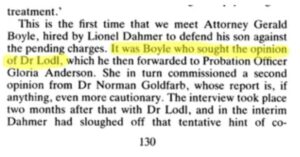
Dr. Charles Lodl served as Jeff’s psychologist (see The Shrine of Jeffrey Dahmer by Brian Masters, p. 130) and then later sat on the Diocesan Review Board…personally appointed to “oversee the Archdiocese of Milwaukee’s response to clergy sexual abuse”.
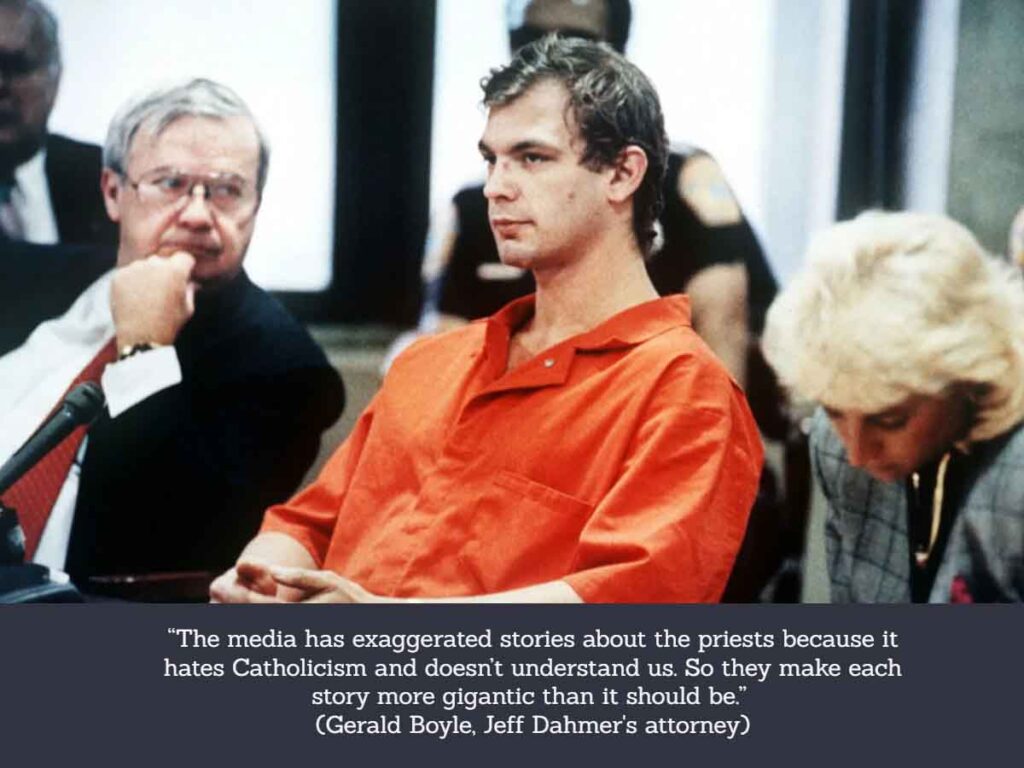
Defense attorney Gerald Boyle? Legal muscle for the Archdiocese, with experience defending priests accused of abusing kids.
Assistant DA Gregory O’Meara, who worked on Jeff Dahmer’s prosecution, later became a Jesuit priest and is now the rector at Marquette University. If you read between the lines of his 2009 academic paper on Jeff Dahmer, you might start to wonder if he was telling you what really happened.
Let’s not forget Lawrence Vuillemin, the Catholic attorney from Akron who defended Jeff, Lionel, and Shari Dahmer in the wrongful death lawsuit filed by the parents of Steven Hicks. He represented priests accused of abuse in the Diocese of Cleveland.
So, the whole thing was handled by people tied directly to the same institution Jeff Dahmer’s trial conveniently diverted attention from.
For more information, see The Milwaukee Archdiocese and the Dahmer Case.