Rev. Gregory O’Meara, S.J., Compares Jeffrey Dahmer to Abraham. It Doesn’t Add Up.
Don't skip this post. It's an Analogy That Never Made Sense.
You might be thinking this doesn’t look important. But it is. Once you see what Gregory O’Meara—a Jesuit priest—is doing, it changes how the official Jeffrey Dahmer narrative reads.
In 2009, Gregory O’Meara, S.J., published a paper analyzing Jeff Dahmer’s 1992 “trial.” This wasn’t written by a distant observer. O’Meara had been an assistant district attorney on the case, and by the time the paper appeared, he was a Jesuit priest.
Most of the paper focuses on silence. Jeff Dahmer barely spoke in court, was never sworn in, never testified, and almost everything attributed to him reached the jury secondhand, filtered through lawyers and experts. In O’Meara’s telling, Jeff appears less like an actor than a figure being managed.
Then, at the end, he makes a comparison that doesn’t actually work.
O’Meara closes by invoking the biblical story of Abraham and Isaac, citing Søren Kierkegaard and Kierkegaard’s claim in Fear and Trembling that Abraham’s silence – his failure to warn Isaac – constituted an ethical failure.
Oddly, O’Meara places Jeff Dahmer in the role of Abraham…the figure whose silence carries moral weight because he knows what is coming and chooses not to speak. In practical terms, O’Meara is treating Jeff’s alleged silence toward his “victims” as an “ethical failure.”
But this comparison doesn’t hold. Jeff Dahmer, “serial killer”, is not Abraham. Kierkegaard is not writing about criminals, lures, or victims. He is writing about a father and a son…about authority that is recognized as legitimate, exercised under obedience to what is believed to be a higher command, and experienced as a moral nightmare by the person who bears it. Abraham’s silence matters because Isaac trusts him, and because Abraham, as his father, owes him the truth.
A criminal’s power over a victim has none of that structure. It isn’t legitimate, recognized, or exercised under obedience to anything but appetite. It doesn’t produce moral anguish; it produces tactics. Once you swap ethical authority for coercion, you’re no longer talking about Kierkegaard at all. You’re just borrowing his props and hoping no one notices.
So whatever one believes about the alleged crimes, Jeff Dahmer simply doesn’t fit the role the analogy assigns him. Which leaves a problem the paper cannot resolve. If Jeff can’t plausibly occupy the role O’Meara’s analogy requires, then the comparison is doing something else…something indirect.

Why O’Meara’s Abraham Analogy Fails
Before going any further, it’s worth reminding the reader of what Gregory O’Meara, S.J. is actually doing here. This isn’t an interpretation I’m imposing on his paper from the outside. It’s his comparison.
In the closing section of his article, O’Meara explicitly aligns Jeff Dahmer’s silence with the silence of Abraham in Kierkegaard’s Fear and Trembling. O’Meara then reinforces the parallel by citing Jacques Derrida’s gloss on Kierkegaard: that Abraham “speaks and doesn’t speak,” using speech itself to avoid saying the essential thing he must keep secret.
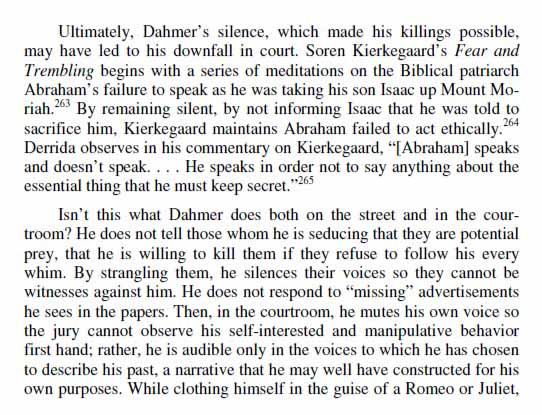
“Ultimately, Dahmer’s silence, which made his killings possible, may have led to his downfall in court. Søren Kierkegaard’s Fear and Trembling begins with a series of meditations on the Biblical patriarch Abraham’s failure to speak as he was taking his son Isaac up Mount Moriah. By remaining silent, by not informing Isaac that he was told to sacrifice him, Kierkegaard maintains Abraham failed to act ethically.
Derrida observes in his commentary on Kierkegaard, ‘[Abraham] speaks and doesn’t speak… He speaks in order not to say anything about the essential thing that he must keep secret.’
Isn’t this what Dahmer does both on the street and in the courtroom? He does not tell those whom he is seducing that they are potential prey, that he is willing to kill them if they refuse to follow his every whim. By strangling them, he silences their voices so they cannot be witnesses against him. He does not respond to “missing” advertisements he sees in the papers. Then, in the courtroom, he ‘mutes’ his own voice so the jury cannot observe his self-interested and manipulative behavior first hand; rather, he is audible only in the voices to which he has chosen to describe his past, a narrative that he may well have constructed for his own purposes.”
— Gregory J. O’Meara, He Speaks Not, Yet He Says Everything; What of That? (2009)
Again, this is the frame O’Meara chooses. And that’s where the problem begins.
If we are talking about a real serial killer – about actual predatory violence – this framing is absurdly understated. Describing a serial killer’s silence as an “ethical failure” is like saying a bank robber who shoots a guard “failed to practice proper firearm safety.” The words technically describe something that happened, but they completely miss the moral category that matters.
If Jeff Dahmer really did what he was accused of, his silence toward victims wouldn’t be an ethical lapse. It wouldn’t be a moral dilemma. It wouldn’t belong to the realm of conscience or anguish or restraint. It would be part of the crime itself. Predation isn’t ethically complicated. It doesn’t tremble. It doesn’t struggle. It deceives because deception is the mechanism of harm.
Yet O’Meara insists on reading Jeff Dahmer’s silence through Kierkegaard’s Abraham…a figure defined not by manipulation, but by obedience; not by domination, but by moral anguish. Abraham’s silence matters because it violates a duty owed within a relationship of trust.
That is not the moral universe of a “serial killer”. Which leaves an unavoidable question: why describe monstrous predation in the language of ethical burden? If we take O’Meara’s comparison seriously, we must accept that it fails completely if read at face value.
If you want to examine the Dahmer case directly, start with the records:
→ Was Konerak Sinthasomphone Even Real?
→ Richard Guerrero Died in 1960
→ Who Was “Eddie Smith” in the Dahmer Case?
→ Is This Man Curtis Straughter?

If Jeff Isn’t Abraham, Who Is?
Once you accept that Jeff-as-Abraham doesn’t work, the question practically asks itself: who does?
In Fear and Trembling, Søren Kierkegaard’s Abraham isn’t defined by violence or deception. He’s defined by position. He is the one who receives the command. He understands the stakes. He has authority. And he believes obedience requires silence, even when that silence carries ethical cost.
That description fits poorly when applied to a supposed serial killer. But it starts to make uncomfortable sense when applied elsewhere.
Consider who actually possessed authority in this case that we now know was fabricated. Who controlled the process? Who knew what evidence would be shown, what would be withheld, who would speak, and who would not. Prosecutors like Michael McCann. Judges. Defense counsel. The justice system itself. If anyone in this story occupies Abraham’s position, it’s not Jeff Dahmer. It’s authority.
Read that way, the moral language O’Meara uses suddenly makes more sense. Silence becomes an ethical problem not because a “predator” hid his intent, but because people in power believed they couldn’t – or shouldn’t – say everything they knew. Obedience comes first. Ethical cost comes later.
And Jeff?
Jeff fits Isaac far more cleanly than Abraham. Silent. Compliant. Deprived of full knowledge. Led through a process he does not fully understand by authorities he assumes are acting legitimately. Not choosing silence as a moral act, but subjected to it.
Given that the story about Jeff Dahmer was fabricated, the Abraham analogy only makes sense when authority occupies Abraham’s position and Jeff occupies Isaac’s. Read this way, the strange understatement, the philosophical detour, and the obsession with silence all fall into place.
Which suggests O’Meara may be signaling an ethical problem he cannot name directly…by assigning it to the wrong character and letting the mismatch do the work.
It’s also possible the analogy is more personal—that O’Meara is not pointing to the system as a whole, but to his own position within it. By the time he wrote the paper, he occupied a role where obedience and restraint are not optional.
What Changes Once You Realize the Story About Jeff Dahmer Was Fabricated
Comparing Jeff Dahmer, “serial killer,” to Abraham never made sense on its face. But as long as you believe the official story, the mismatch gets dismissed. You chalk it up to a strange philosophical flourish and move on, because there’s nowhere else for it to land.
Once you realize the story about Jeff is false, the Abraham analogy stops looking clumsy and starts looking intentional…a hint left in the open. You start asking why a careful Jesuit lawyer would end a tightly controlled paper about a fabricated story with a comparison that fails this badly.
Frequently Asked Questions about Gregory O’Meara, S.J.
Who is Gregory O’Meara, S.J.?
Gregory O’Meara is a Jesuit priest, legal scholar, and administrator. He is currently the rector of Marquette University, a Jesuit institution in Milwaukee.
What role did Gregory O’Meara, S.J. play in the Dahmer trial?
O’Meara served as an assistant district attorney in Milwaukee and was directly involved in the prosecution of Jeff Dahmer. His later academic writing on the trial was authored by someone who participated in the legal process, not by an outside commentator or historian.
Does Gregory O’Meara, S.J. openly admit the Dahmer case was fabricated?
No. O’Meara never states this directly. In his 2009 paper, He Speaks Not, Yet He Says Everything; What of That?, the implication emerges indirectly: his closing Abraham analogy only makes sense if the official story itself is false.