Jeff Dahmer and the Moral Life of a Compromise

What Does 35 Years Change?
I’ve argued before that Jeff Dahmer could have agreed to participate in the story told about him and still have been coerced. Those possibilities aren’t mutually exclusive.
A person can say yes when the choices available to him are severely constrained.
I can imagine many reasons a young man might say yes.
Fear is one of them.
He may have believed he was in serious danger. He may have been offered a way out of some other predicament. He may have been threatened, deceived, pressured, or promised something he desperately wanted. He may have been presented with two choices when neither was really a choice at all.
He may even have believed that whatever he was agreeing to wouldn’t last very long.
We don’t have to know precisely what happened to understand the principle. There are circumstances in which a person can consent to something without being meaningfully free. People make bargains because the alternative seems unbearable. Sometimes survival narrows the moral universe until the only question left is how to get through the next hour, the next day, the next year.
If that was Jeff’s position in 1991, I can understand why he might have agreed to play a serial killer.
But 1991 was thirty-five years ago.
And time changes the question.
It’s one thing to ask what a frightened man might agree to when he believes himself trapped. It’s another to ask what happens after the immediate danger has passed, or after the arrangement itself has become familiar.
Five years pass. Then ten. Then twenty. Then thirty-five.
The original decision remains part of the story. It may even explain everything that follows. But explanation isn’t the same thing as exemption. At some point, we have to ask not only why someone entered an arrangement, but why he remained inside it.
Perhaps the answer is still fear. Perhaps there are consequences we can’t see. Perhaps leaving became more difficult with every passing year.
All of those possibilities matter. But so does another possibility. Perhaps, somewhere along the way, staying became easier than leaving.
And that’s where the question of what was done to Jeff meets the question of what Jeff chose to do afterward.
When a Compromise Becomes a Life
A compromise made in fear doesn’t remain frozen in the moment it was made.
Years pass. An arrangement becomes familiar. A life forms around it. There may be money, security, relationships, protection, an identity. Eventually, leaving may mean losing everything that staying has provided.
There may never be a clean moment when coercion ends, and free choice begins.
Perhaps coercion never ended.
But neither did choice.
A person can resent an arrangement and still depend upon it. He can want freedom and still fear what freedom might cost him.
There’s another way of looking at this problem. I’ve argued elsewhere that Jeff’s situation bears many of the characteristics of human trafficking: coercion or deception, control, exploitation, and a life increasingly organized around the people and circumstances that hold the arrangement in place. Trafficking doesn’t require a victim to spend every moment trying to escape. Dependence can become part of the control mechanism.
That doesn’t make the original coercion any less real. But after thirty-five years, it does make the question of responsibility more complicated.
The Cost of Living a Lie
But safety has a cost too.
If Jeff has spent thirty-five years participating in a story he knows isn’t true, the price wouldn’t only be measured in what he gave up or what he was prevented from doing. There would also be the cost of living inside the deception itself.
It’s one thing to tell a lie once. It’s another to build a life around one.
You have to remember what can be said and what can’t. You have to allow people to believe things you know aren’t true. You may form genuine relationships with people while knowing there are things about yourself you can never tell them. Eventually, the deception isn’t something you occasionally perform. It becomes part of the structure of everyday life.
And there is another cost that’s harder to see.
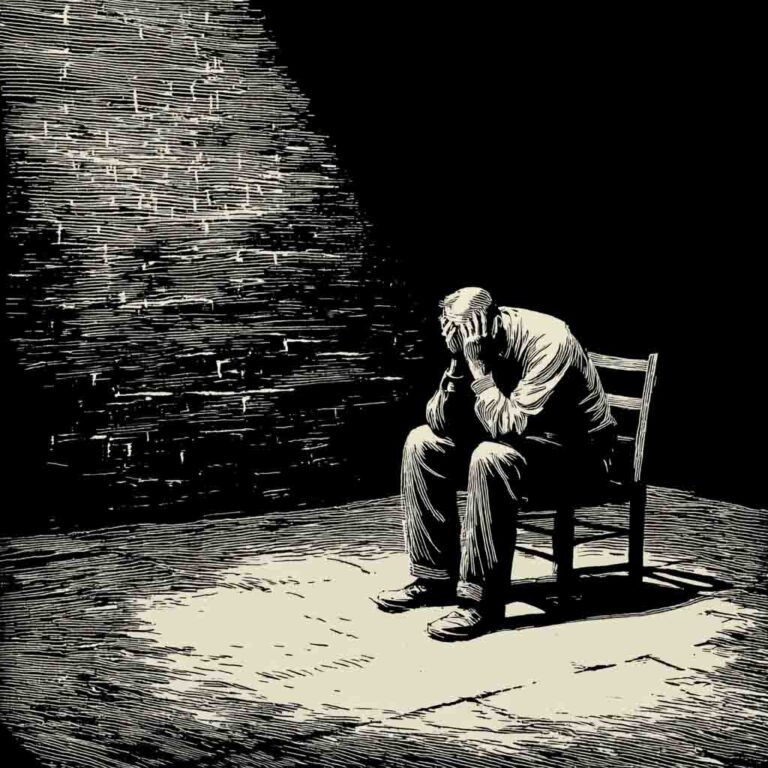
What happens to your relationship with yourself when you spend years participating in something you know isn’t true? Even if you disagree privately, even if you tell yourself you’re only doing what you have to do, you’re still living outwardly in contradiction with what you know inwardly.
That kind of inauthenticity must extract a price.
If I’m right, Jeff has had to watch an invented version of himself become one of the most recognizable monsters in American culture. He has had to watch strangers discuss that person, analyze him, diagnose him, sexualize him, condemn him, and turn him into entertainment.
And he has also had to remain silent. But necessity doesn’t make inauthenticity painless.
A compromise can protect a person from one kind of danger while creating another: the risk of gradually losing the ability to respect himself.
Neither Monster Nor Saint
Victimhood doesn’t require perfection.
If Jeff wasn’t the monster we were given, it doesn’t follow that every choice he made was beyond moral judgment. Being wronged doesn’t turn a person into what we might call an immaculate victim, a man to whom everything was done and for whom every choice that followed can therefore be excused.
The opposite of a monster isn’t a saint. It’s a human being. And restoring Jeff’s humanity means restoring his agency.
A person can be wronged and still make bad choices. He can be exploited and still cooperate with those exploiting him. He can be coerced without becoming morally inert. Compassion doesn’t require us to pretend that every choice was a good one.
None of this diminishes the wrong that was done to Jeff. The responsibility of the people who harmed him remains theirs.
But their responsibility doesn’t erase his.
When Other People Become Part of the Lie
A deception that lasts for decades can’t remain contained among the people who created it.
Other people enter your life. Friendships form. People trust you. They care about you. And if the truth about who you are or what happened to you has to remain hidden, those relationships eventually become entangled in the deception too.
That doesn’t necessarily make the relationships false. In some ways, that makes the problem harder.
Jeff could genuinely care about someone and still allow that person to believe something he knew wasn’t true. He could value a friendship while withholding the one fact that might completely change the other person’s understanding of it.
If Jeff remained connected to the people behind the arrangement, his cooperation helped preserve it whether or not he shared their purposes. He could distrust them, resent them, even feel trapped by them.
But he could still be useful to them.
The question then becomes more than: Why didn’t you leave?
It becomes: What were you helping them do by staying?
Roy Ratcliff may be one of the people who became caught in the consequences.
If Ratcliff wasn’t part of the arrangement, Jeff allowed a man who baptized him, counseled him, visited him, and became his friend to believe something fundamental that Jeff knew wasn’t true. Ratcliff went on believing that his friend had met a horrible, violent death. He grieved a death that Jeff knew had never happened.
That doesn’t mean their friendship wasn’t sincere. Jeff could genuinely have cared about Ratcliff. His religious concerns could have been sincere.
And he could still have deceived him.
What if Ratcliff knows the truth now? I sometimes wonder what he thinks. What does he make of the man he baptized and counseled, the man he regarded as his friend? Does knowing change the way he remembers those conversations? Does he understand? Does he forgive him?
I don’t know.
But that’s one of the costs of maintaining a deception. Eventually, people who had nothing to do with the original bargain are made to live inside the lie too.
This is where participation begins to shade into complicity.
What Do We Owe the Truth?
If Jeff agreed to participate in this deception in 1991 because he was frightened or coerced, I can understand that.
What is harder to understand is continuing to participate in it for thirty-five years.
There may be good reasons why he has stayed. Maybe he’s still afraid. Maybe there are consequences or obligations we know nothing about. After all this time, walking away could mean giving up his security, his identity, or the life he has built for himself.
Those things matter.
But the deception has consequences too.
The story of Jeffrey Dahmer entered the culture as a lesson about what human beings are capable of. Psychologists have studied the case. Professionals have used it to explain human behavior. Ordinary people have absorbed it into their understanding of strangers, neighbors, danger and trust.
And this isn’t an ordinary story. It’s saturated with sex, violence, mutilation and degradation. It has been repeated and dramatized for decades because the horror itself is part of the attraction. In that sense, it operates almost like pornography: people return to the intimate details precisely because they are shocking and forbidden.
That has a psychological cost.
And at some point, protecting yourself also means allowing the story to keep imposing that cost on other people.
Perhaps Jeff believes he has no real choice. Perhaps sometimes he simply chooses safety.
I don’t know.
But fear can explain a choice without making that choice admirable. And believing Jeff was wronged doesn’t require treating every choice he may have made afterward as beyond moral judgment.
Some choices can be understandable without being admirable.
Perhaps that’s the moral life of a compromise.